

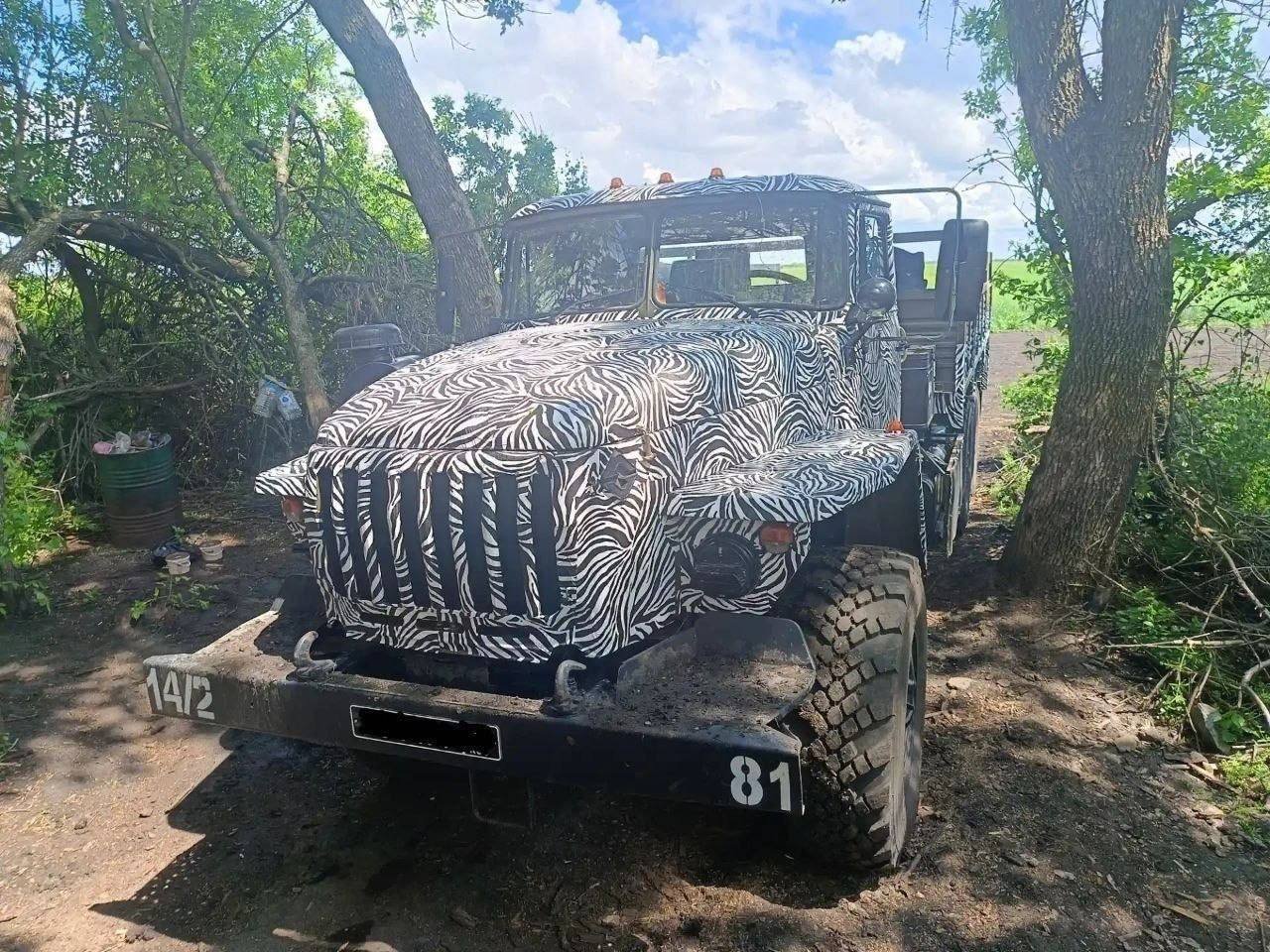
Russia zebra camouflage AI drones has become a major talking point after images emerged showing military vehicles painted with striking black-and-white patterns inspired by a World War I strategy.
As drone warfare continues to reshape the battlefield in Ukraine, Russia appears to be turning to an unlikely source for protection — a camouflage technique developed more than a century ago.
The unusual paint scheme, known as “Dazzle” camouflage, covers military trucks and armored vehicles with bold geometric black-and-white patterns. Unlike traditional camouflage, the goal is not to hide the vehicle from view.
Instead, the design aims to confuse targeting systems and make it more difficult for AI-powered drones to accurately identify, track and strike moving targets.
Military historians trace the origins of Dazzle camouflage back to 1917. British naval artist Norman Wilkinson developed the technique to protect ships from German submarine attacks during World War I.
The distinctive patterns distorted a vessel’s appearance, making it harder for enemy observers to estimate its speed, direction and size through a periscope.
More than a century later, Russia appears to believe the same concept could help defend vehicles against modern artificial intelligence systems used in attack drones.
Photos circulating online show several Kamaz and Ural military trucks painted with zebra-like patterns. The images quickly sparked debate among military analysts and technology experts.
Some Ukrainian military officials have dismissed the strategy. They argue that vehicle paint will not stop Ukrainian forces from identifying and destroying targets on the battlefield.
However, some experts in aerospace engineering and artificial intelligence believe the concept may have merit. They suggest that unusual visual patterns could temporarily reduce the accuracy of certain AI-powered recognition systems.
Even so, specialists note that machine-learning systems can be retrained over time. As more images of the camouflage become available, AI models may eventually learn to recognize the patterns with greater accuracy.
Another challenge for Russia is that many Ukrainian drones are not fully autonomous. Human operators often assist with target identification and guidance, reducing the potential effectiveness of visual deception techniques.
Despite the uncertainty, Russia’s revival of a century-old military strategy highlights how modern warfare is blending historical tactics with cutting-edge technology in unexpected ways.