

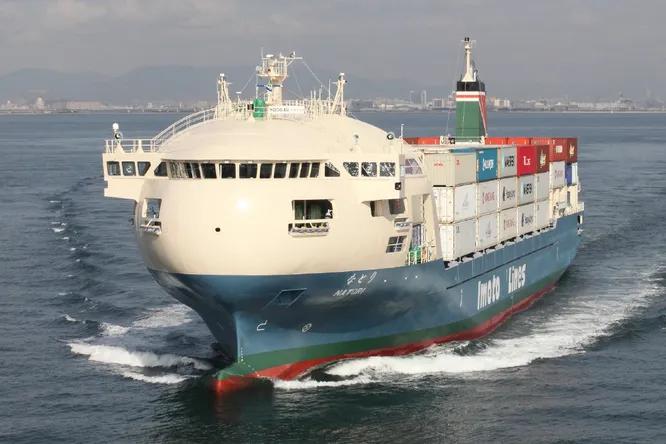
A Japanese shipping company has attracted global attention with a futuristic cargo ship design that looks more like a giant passenger airplane than a traditional vessel.
The unusual ships, operated by Imoto Lines, feature a rounded front structure inspired by the nose of large commercial aircraft such as Airbus jets.
The innovative design was first introduced in 2015 when the Japanese shipyard Kyokuyo completed the construction of the vessel known as Natori.
Unlike conventional cargo ships with sharp bows, the Natori featured a semi-spherical front section designed to improve aerodynamics and fuel efficiency.
The vessel quickly gained international recognition because the strange airplane-like nose was not just for appearance — it significantly improved performance.
According to reports, the rounded bow design reduced air resistance by nearly 50% compared to traditional cargo vessels.
Engineers also reported that the ship consumed about 5% less fuel under various loading conditions, helping lower operating costs and reduce harmful emissions.
The innovation earned the Natori the prestigious “Ship of the Year” award from the Japan Society of Naval Architects and Oceanographers.
Another major advantage of the futuristic design was its cargo capacity.
Despite being a relatively compact feeder vessel, the Natori reportedly carried almost double the amount of containers compared to conventional ships of similar size.
Following the success of the original vessel, Imoto Lines expanded the concept by launching additional airplane-nose cargo ships.
In 2018, another vessel called Nagara joined the fleet, followed by the larger Nogami in 2022.
The newer ships reportedly increased carrying capacity even further while maintaining the same energy-efficient design philosophy.
The futuristic vessels have since become symbols of modern maritime engineering and environmentally conscious shipping technology.
Many experts believe innovative ship designs like these could play a major role in reducing fuel consumption and emissions in the global shipping industry.
The bizarre yet functional appearance of the ships has also made them popular online, with many social media users comparing them to floating airplanes or science fiction vehicles.